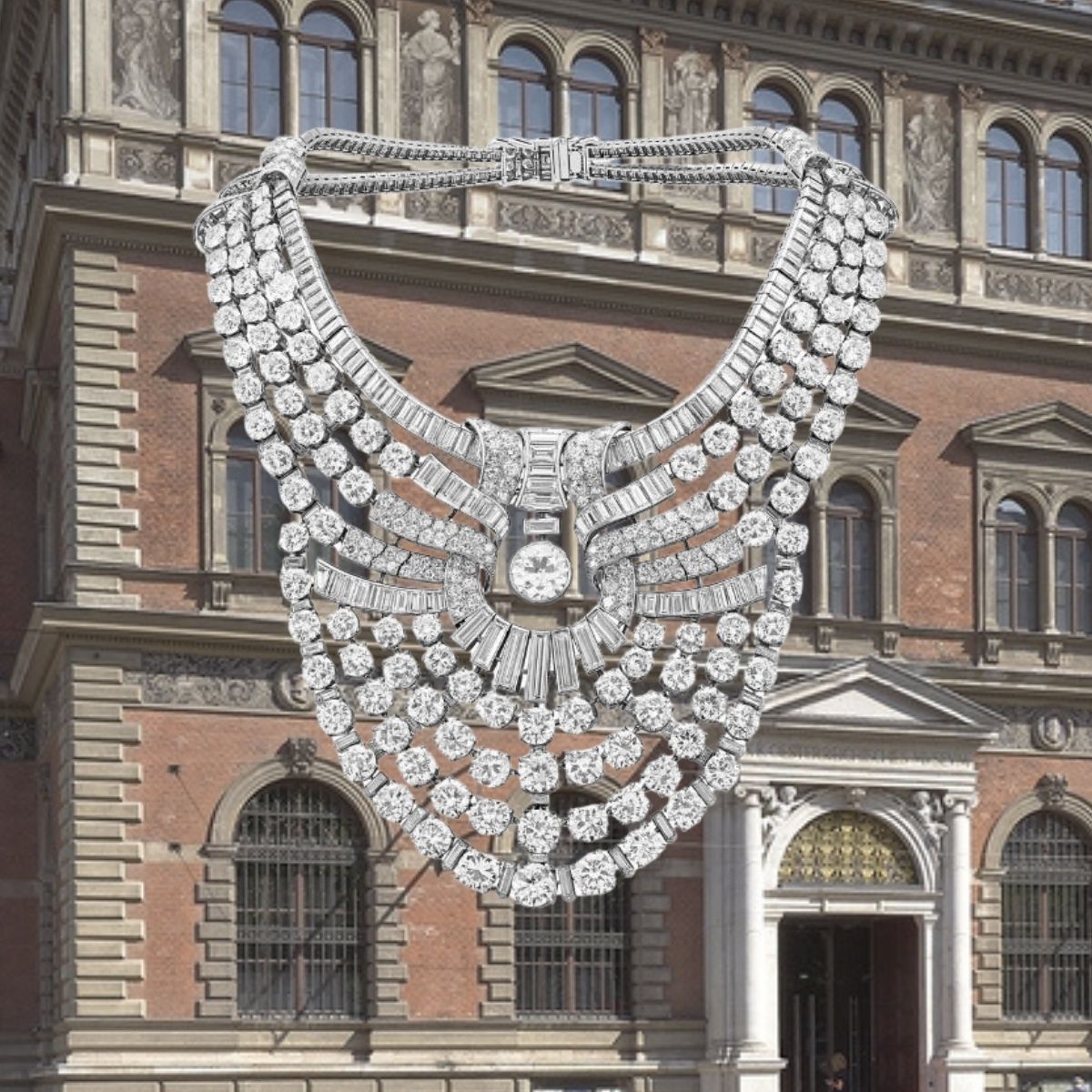
Last Thursday, two men did something that sounds more Netflix than Vienna.
They bought ordinary entrance tickets to the MAK, walked into Glanzstücke, the museum’s Van Cleef & Arpels exhibition, smashed a display case with a hammer and left with one of the most extraordinary diamond necklaces of the 20th century.
No masks. Middle of the afternoon. Museum visitors standing nearby. One of the men was carrying what police believe was a real firearm. Both escaped on foot towards Stadtpark and, as of 31 August, an international search is still under way.
And because I live in Vienna and write about jewellery, I have been slightly obsessed with the story ever since. What happens now?
You cannot exactly walk into Dorotheum on Monday morning carrying the stolen necklace of an Egyptian queen and ask whether they have a free valuation appointment. So where does a jewel like this go after it disappears from a museum?
First, the Necklace
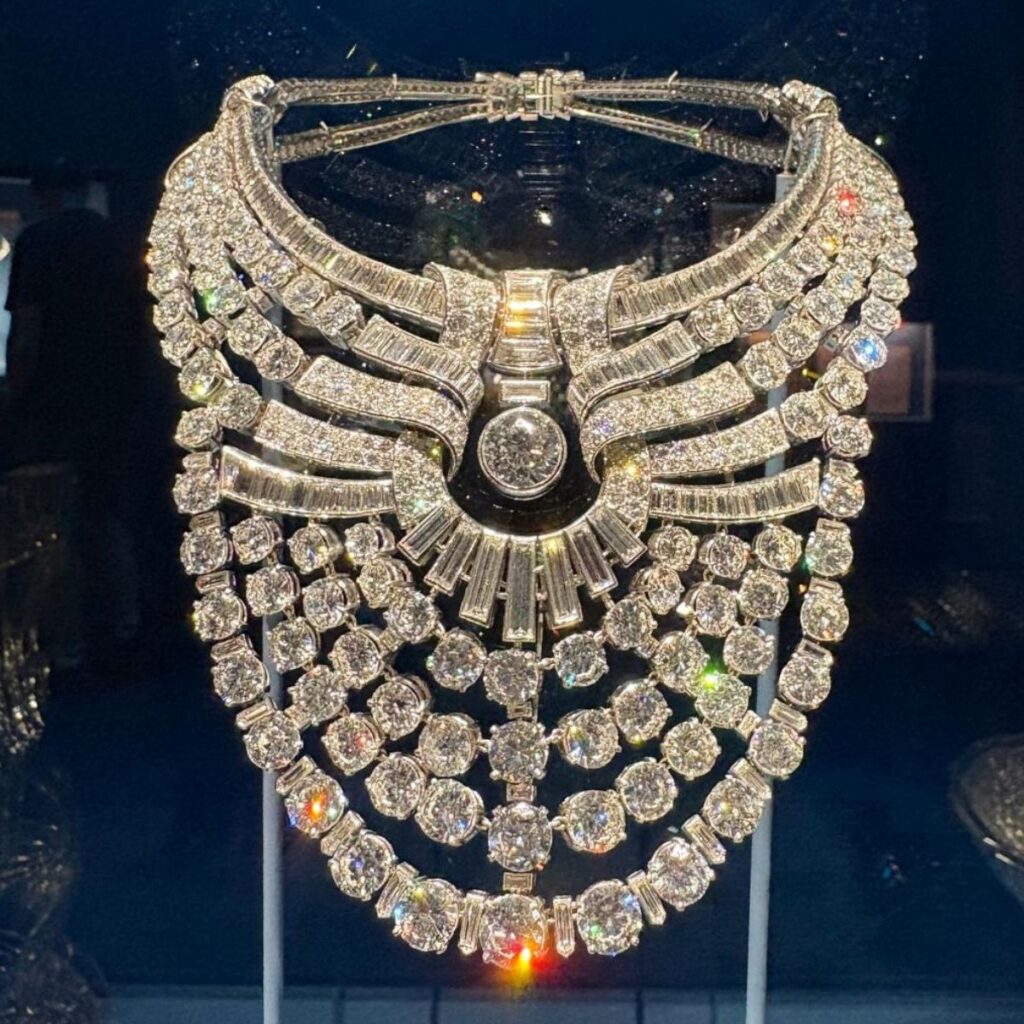
Queen Nazli of Egypt’s necklace, made by Van Cleef & Arpels in 1939.
The piece stolen from the MAK belonged to Queen Nazli of Egypt and was made by Van Cleef & Arpels in 1939. She wore it at the wedding of her daughter Princess Fawzia to Mohammad Reza Pahlavi, then crown prince and later Shah of Iran.
It is enormous by modern high-jewellery standards: a flexible platinum bib in a sunburst design, set with more than 600 round and baguette diamonds. Sotheby’s catalogued approximately 217 carats of diamonds, including a central stone of around six carats. In 2015, the necklace sold in New York for $4.3 million.
The interesting part is that even before the robbery, jewellery specialists considered its survival remarkable.
When Sotheby’s sold it, Frank Everett described how easily such a piece could have been broken up during the decades after Queen Nazli owned it. The individual diamonds were valuable enough to tempt any owner who needed money. Somehow, the necklace survived intact for almost ninety years.
Which makes what may happen to it now especially painful.
Europe Has Been Having a Very Bad Year at the Museum
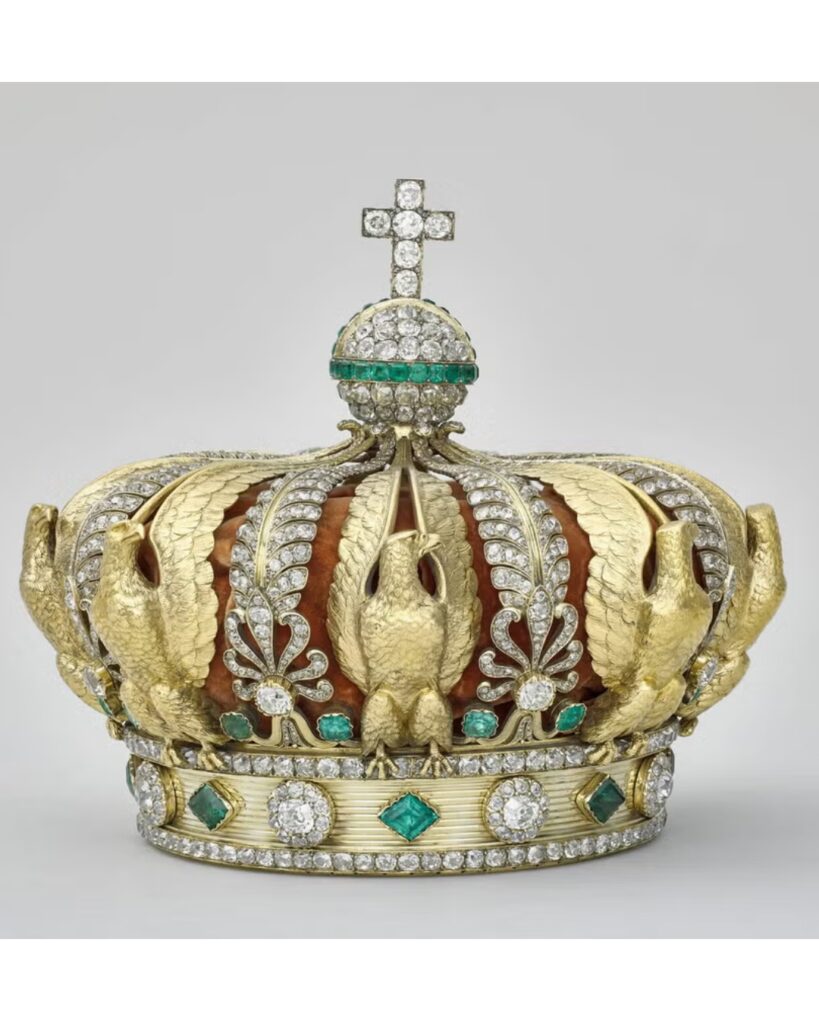
The Crown of Empress Eugénie is a diamond and emerald tiara created in 1855 by Alexandre-Gabriel Lemonnier for Eugénie de Montijo, wife of Emperor Napoleon III
The Vienna robbery feels extraordinary until you look at what has been happening elsewhere.
In October 2025, thieves entered the Louvre’s Galerie d’Apollon and stole French Crown jewellery belonging to figures including Empress Eugénie and Queen Marie-Amélie. Eight pieces remain missing. Interpol immediately placed them in its Stolen Works of Art database.
In January 2025, thieves used explosives to enter the Drents Museum in the Netherlands and steal ancient Romanian gold, including the Coțofenești helmet and three bracelets.
This July, 27 pieces of Art Nouveau and Art Deco jewellery and decorative art worth around €4.5 million were stolen from the Musée Lalique in Alsace. Another French museum lost a 2,500-year-old gold torque.
Then, rather eerily, on the same day as the Vienna robbery, thieves attacked the museum in Villena, Spain, and removed much of its famous Bronze Age gold treasure. The operation reportedly took about four minutes.
Europol had published a report on this phenomenon only three days before Queen Nazli’s necklace vanished.
The conclusion was uncomfortable: museum thieves are becoming more aggressive, and gold, gemstones and portable precious objects have become particularly attractive targets.
And What About the Famous “School of Turin”?

Agim De Bruycker, the detective who solved one of the most audacious diamond heists in history performed by a gang known as The School of Turin.
Here we arrive at one of my favourite details in the strange anthropology of jewellery crime: the School of Turin.
Sadly, there is no diploma. No evening course in Safecracking I followed by Advanced Alarm Systems on Tuesdays.
The name describes a loose circle of highly skilled professional thieves who operated around Turin, sharing knowledge and assembling different specialists depending on the robbery.
Their most famous alumnus, if one may use the word, was Leonardo Notarbartolo, mastermind of the 2003 Antwerp Diamond Center robbery. Check on Netflix: Stolen; Heist of the Century, a true-crime documentary.
The group spent years preparing. Notarbartolo rented an office inside the Diamond Center and behaved like a legitimate diamond merchant while studying the building. His team included people with expertise in locks, electronics, alarms and safes. They eventually opened 109 safe-deposit boxes and stole more than $100 million in diamonds, jewellery and other valuables. Most of the diamonds were never recovered.
The School of Turin was not a formal criminal organisation. Research on the Antwerp robbery describes it as a loose network in which thieves exchanged expertise and often had skills acquired through perfectly ordinary professions. Alarm systems, locksmithing, electronics: useful trades can apparently develop an unfortunate second career.
What makes the story particularly relevant today is how different their philosophy was.
They preferred patience and technical skill. Ideally, nobody even knew there had been a robbery until the following morning.
Europol says the new generation increasingly uses the opposite method: hammers, axes, guns and explosives. Some crews appear to be assembled specifically for individual jobs, with criminals recruited from other fields and, in some cases, through social media or encrypted messaging.
Ocean’s Eleven has become rather more primitive.
So Who Is Behind a Museum Heist?
This is where films have probably done permanent damage to our imagination.
We like the idea of the sophisticated billionaire collector ordering a particular necklace for his underground drawing room in Geneva. A little Dr No, a little Thomas Crown Affair.
Reality is generally less elegant.
Investigators see professional burglary networks, organised-crime contacts, opportunistic groups and specialist thieves moving between different criminal markets. Europol has also identified what it calls a possible “crime-as-a-service” model, where people with specific skills are brought together for one operation.
There is currently no public evidence identifying the organisation behind the MAK theft, so it would be premature to attach the Vienna thieves to the School of Turin, the Pink Panthers or any other famous group.
Police know what the two men look like. They know how they entered. They know one was armed. What remains unknown is who sent them, if anyone did, and where the necklace went after Stadtpark.
What Happens to Stolen Museum Jewellery?
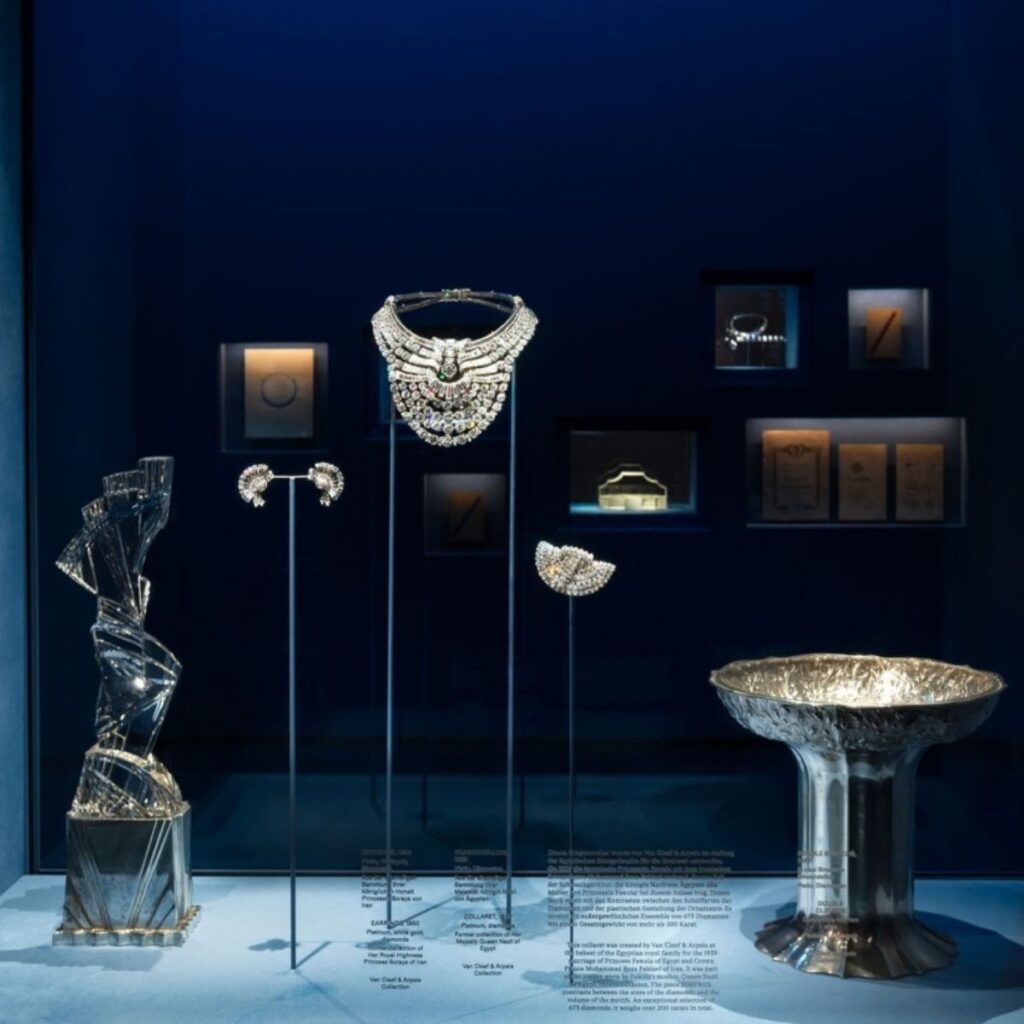
GLANZSTÜCKE Van Cleef & Arpels High Jewelry × Masterpieces from the MAK Collection
Here the answer becomes rather brutal. A historic jewel has two kinds of value.
Queen Nazli’s necklace is worth millions because it is a Van Cleef & Arpels masterpiece, because it survived from 1939, because it belonged to Egyptian royalty and because those hundreds of diamonds still sit in the arrangement conceived by the jeweller.
Once stolen, much of that value becomes a liability.
Everybody knows what the necklace looks like. Auction houses know it. Dealers know it. Insurers know it. Police know it. Interpol now has it in its stolen-art database. Selling the necklace intact through the legitimate jewellery market would be extremely difficult.
The raw materials are another matter.
Europol specifically warns that gold can be melted and gemstones removed from their settings. Once a historic jewel has been dismantled, the object that police are looking for no longer exists in the same form.
Diamonds can circulate separately. Some can be recut, although doing so sacrifices weight and therefore money. Larger or unusual stones may still be recognisable through documentation, measurements, inclusions and previous records, which makes disposing of a famous collection more complicated than selling anonymous commercial stones.
But the economics are cruelly simple.
A thief does not need to obtain the $4.3 million auction value of Queen Nazli’s necklace. That price included its maker, design, history and royal provenance.
Destroy the necklace and all of that disappears. What remains is platinum and diamonds.
A jewel can therefore be worth less to the criminal because it has survived intact.
And What Happens to a Stolen Painting?
A Cézanne has the opposite problem.
You cannot melt it into generic Cézanne.
A painting by a famous artist derives its value precisely from remaining recognisable as that particular work. Cut it up, repaint it or remove the signature and you have destroyed the reason anyone wanted it.
That makes major paintings surprisingly awkward criminal assets.
They may be hidden for years, moved within illegal markets at a fraction of their legitimate value, or used as leverage inside criminal networks. The romantic idea of a collector secretly hanging a stolen Vermeer above the bathtub does exist in fiction far more comfortably than it does as a business model.
And paintings sometimes come home.
In March this year, thieves took works by Cézanne, Renoir and Matisse worth more than €9 million from the Fondazione Magnani Rocca near Parma. The robbery lasted under three minutes.
Five months later, Italian Carabinieri found all three works in an apartment in Parma.
A necklace has less protection from its own fame. Its components have independent value.
That is why jewellery may actually be more vulnerable than painting.
The Saddest Possible Ending for Queen Nazli’s Necklace
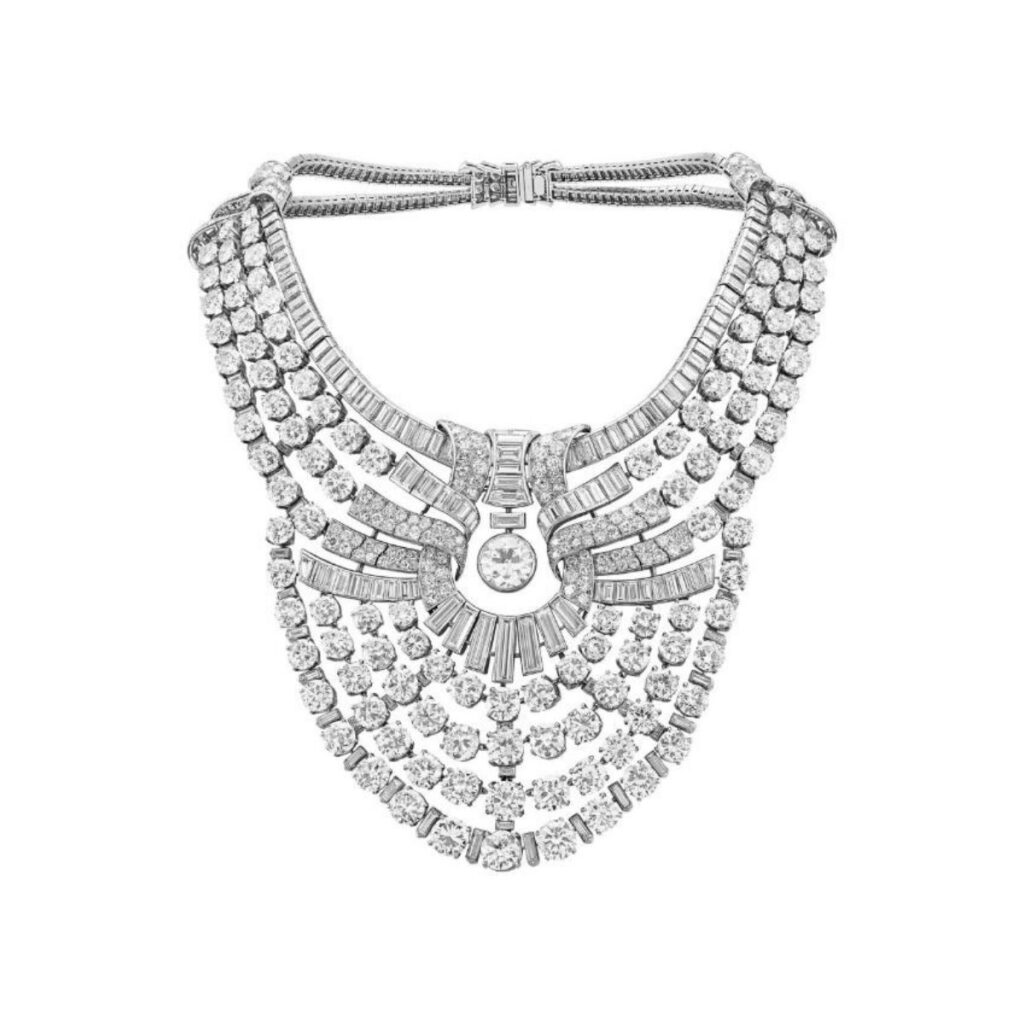
The more than 200-carat necklace was worn by Queen Nazli in 1939 for the marriage of her daughter to the future Shah of Iran
Of course, the necklace may still be sitting intact somewhere.
The men could have been working for someone who intends to keep it. They may be waiting until police attention diminishes. The piece could eventually be recovered, as other famous stolen jewels have been.
At this stage, nobody outside the investigation knows.
But the possibility that bothers me most is much more mundane.
Imagine a necklace surviving a monarchy, exile, family tragedy, auctions, changing fashions and almost ninety years of owners. It crosses from Cairo to America and eventually returns to Europe. Museums preserve it because the arrangement of those stones tells a story that loose diamonds never could.
Then someone takes out a pair of pliers.
That is the strange thing about stealing jewellery from history.
The diamonds can survive perfectly well.
The jewel may not.
FAQ: What Happens to Stolen Museum Jewellery?
| Can stolen museum jewellery be sold? | Famous pieces are extremely difficult to sell intact on the legitimate market because museums, police, insurers, auction houses and databases such as Interpol’s can identify them. Criminals may instead dismantle the jewellery and sell its materials separately. |
| Do thieves melt stolen museum jewellery? | It can happen, particularly with objects containing gold or other precious metals. Europol identifies melting precious metal and removing stones as important reasons jewellery and gold artefacts appeal to thieves. |
| Can stolen diamonds be traced? | Distinctive diamonds can sometimes be recognised through previous records and their individual physical characteristics. Recutting a stone can make identification harder, although it also reduces the diamond’s weight and value. |
| Was the necklace stolen from the MAK in Vienna recovered? | As of 31 August 2026, Queen Nazli’s Van Cleef & Arpels necklace has not been publicly reported recovered, and authorities are still searching internationally for the two suspects. |
Images @wikimedia commons, @notorious, @netflix, @vancleef&arpels