The cross necklace is one of those rare accessories that can be both deeply personal and immediately understood. Worn close to the heart, it may remind us of our faith, a First Communion, a grandmother or simply the promise that we are not alone.
It also communicates something. A cross is never quite as neutral as a gold chain or diamond pendant. Even when fashion adopts it, the symbol still speaks of Christianity.
But is there a rule for wearing a cross? Is it exclusively Christian? Can you layer it with other necklaces? And when did people begin wearing crosses as jewellery in the first place?
Let’s explore this together.
The cross is a Christian symbol—and a positive one
The cross represents the Crucifixion of Jesus, but the Christian story does not finish on Good Friday. It continues with the Resurrection.
That distinction matters. The cross is not worn to celebrate suffering or death. It represents Christ’s sacrifice, the forgiveness of sins and the promise of eternal life. It is, ultimately, a symbol of hope.
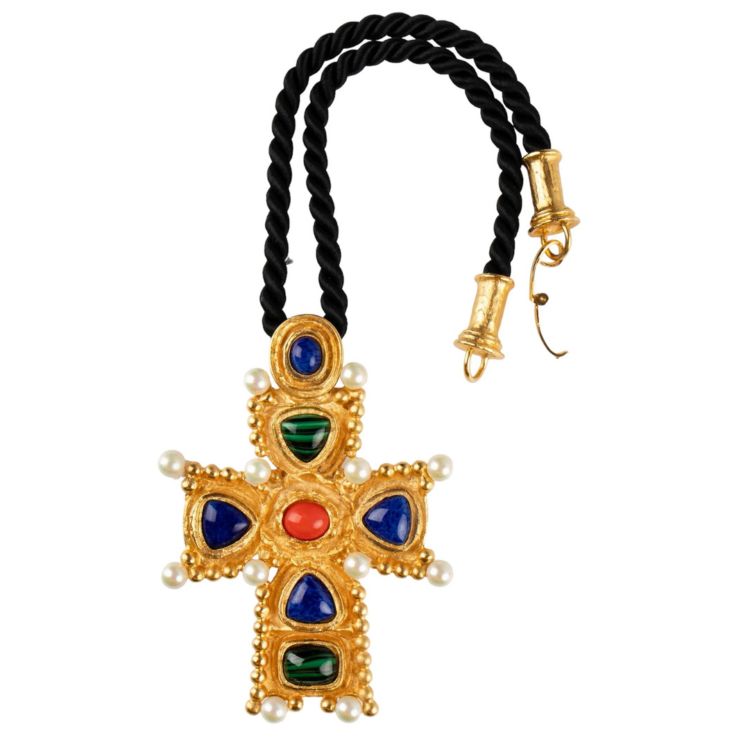
©Christian Lacroix
Early Christians already made the sign of the cross, but they did not display the symbol as openly as we do today. Crucifixion was still associated with humiliation, and Christians were persecuted. Crosses sometimes appeared discreetly within other forms, including the anchor. By the third century, Christian writers described believers making the sign of the cross as part of daily life.
That is almost all the history we need before opening the jewellery box.
When did people begin wearing cross necklaces?
There is no single queen who woke up one morning, added a cross to a gold chain and invented the cross necklace.
As Christianity became established across Europe, crosses appeared on religious objects, royal insignia, reliquaries and personal pendants. Kings, queens and noble families commissioned versions in gold, enamel, pearls and coloured gemstones. Some contained tiny relics and were worn as expressions of faith, protection and status.
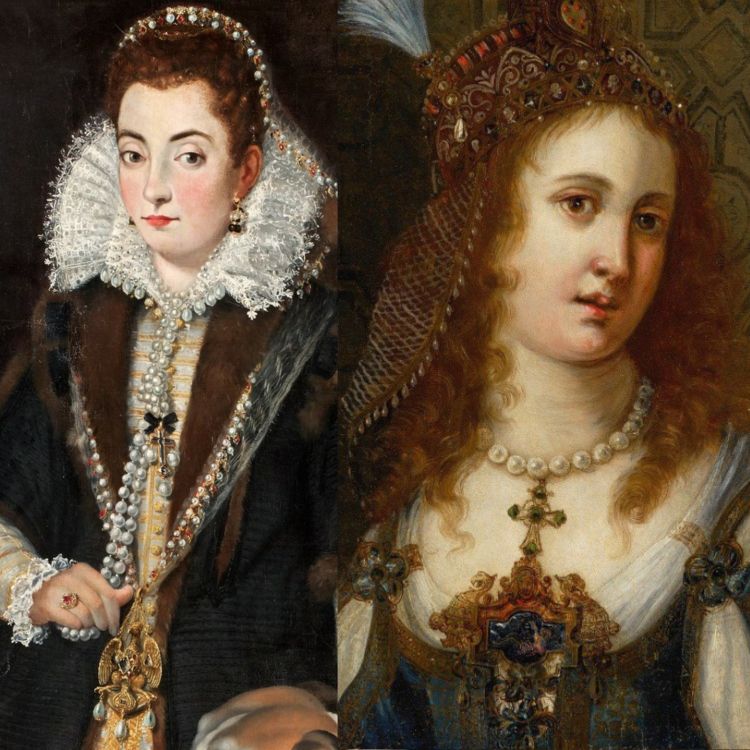
A portrait from the 16th century, Spanish School and Portrait of Virginia de’ Medici
A gold reliquary pendant associated with Queen Margaret of Sicily survives from 1174–77. The Victoria and Albert Museum also holds a German pendant cross from around 1450–75, decorated with symbols of the Passion and possibly designed to contain a relic. Medieval royalty and nobility did not invent the cross as jewellery, but they certainly helped transform it into precious jewellery. The V&A explains how religion, power and jewellery came together in medieval Europe.
And why should a cross always be plain? Christians commissioned beautiful objects because beauty was offered to God. Gold, pearls and gemstones did not necessarily diminish the meaning. Sometimes they intensified it.
The problem is not that a cross is luxurious. The problem is when it becomes meaningless.
From Chanel’s Maltese Cross to Christian Lacroix
Fashion has long understood that the cross has exceptional visual strength.
In 1930, Fulco di Verdura began creating jewellery for Coco Chanel. Inspired by Byzantine art, he designed the famous Maltese Cross cuffs: broad white-enamel bracelets decorated with multicoloured stones surrounding a cross with eight points. Chanel wore them in pairs, often with her ropes of pearls.
They were not delicate devotional crosses. They were bold, colourful and unmistakably Chanel. Verdura took a historic Christian form and turned it into one of the most recognisable jewels of 20th-century fashion.
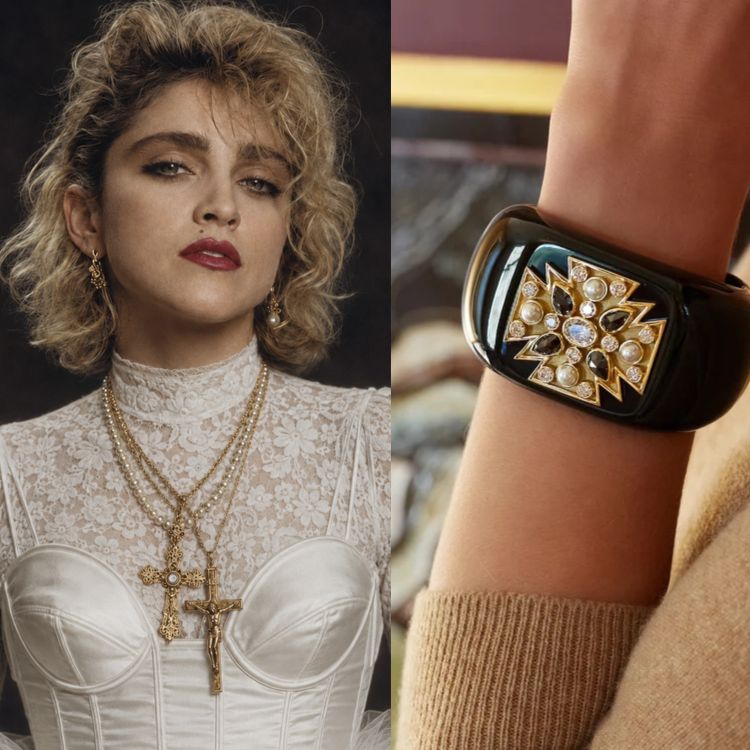
Like a Virgin’s Era and Verdura’s Cuff
Decades later, Christian Lacroix brought the cross into his baroque universe of Provençal colour, Catholic processions, historical costume and glorious excess. His crosses looked like small reliquaries discovered in a church treasury and invited to Paris Fashion Week.
Set with coloured crystals and surrounded by gilt metal, they were intended to be noticed. Lacroix understood something modern minimalism occasionally forgets: faith does not have to be beige.
Dolce & Gabbana made Catholic imagery part of fashion
With Dolce & Gabbana, the cross became Sicilian.
The designers repeatedly combined crosses and rosaries with black lace, corsetry, widow’s veils, sacred hearts and images of the Virgin Mary. Catholicism in their collections is mixed with family, ceremony, sensuality and the visual drama of southern Italy.
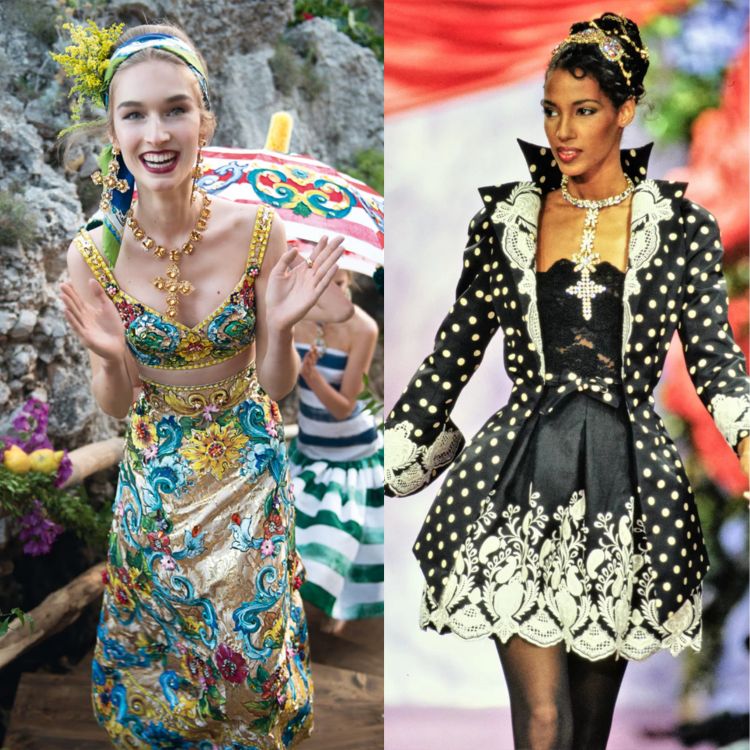
Dolce&Gabbana and Christian Lacroix
For Autumn 2013, they looked to the Byzantine mosaics of Sicily’s Cathedral of Monreale. Images of saints and the Virgin appeared on dresses alongside mosaic gold, crowns, rosaries and ecclesiastical red. It was magnificent, theatrical and just a little dangerous—which is usually preferable to fashion that behaves impeccably. Vogue documented the Catholic references used throughout Dolce & Gabbana’s collections.
The house continues to use elaborate crosses in its fine-jewellery collections. Some are set with coloured gemstones, others with diamonds or pearls. Once again, the cross does not need to whisper in order to be respectful.
Madonna, Like a Virgin and the provocative cross
Madonna understood the cross differently. She recognised its power to provoke.
During the Like a Virgin period, she mixed crucifixes and cross earrings with lace gloves, lingerie, rubber bracelets and bridal references. The tension was deliberate: Catholic symbolism beside female sexuality, innocence beside experience, devotion beside rebellion.
At the first MTV Video Music Awards in 1984, she performed Like a Virgin dressed as a bride. Her Catholic upbringing had become part of her visual language—and part of her confrontation with it.
Young women copied the look almost immediately. A 1985 Time profile described girls buying cross-shaped earrings, lace tights and fluorescent bracelets to dress like Madonna. The cross had moved from the church and the royal court to MTV, where it acquired a new and rather less obedient audience. Read the original Time profile.
Madonna’s use of the cross was provocative precisely because its Christian meaning was still understood. Without that meaning, there would have been no scandal. Just a woman wearing rather a lot of accessories.
Is the cross exclusively Christian?
The shape of the cross existed in different cultures before Christianity, and cross-like forms can carry other historical or decorative meanings. The Maltese Cross, for example, has a specific connection to the Knights Hospitaller and later to the Order of Malta.
But a Latin cross or crucifix worn as a pendant is widely recognised as Christian. A crucifix—the cross bearing the body of Christ—is specifically associated with Christianity and especially with Catholic and Orthodox devotion.
You do not have to pass a theology examination before buying a cross necklace. A non-Christian may appreciate its beauty, inherit one from somebody loved or feel drawn to what it represents.
But wearing a religious symbol without sharing the faith requires a little awareness. The cross is not a lucky charm, a vague talisman or an “edgy” shape emptied of its history. If you choose to wear it, know what you are carrying.
@notorious
Is there a rule for wearing a cross necklace?
There is no Christian dress code specifying the correct metal, size or chain length.
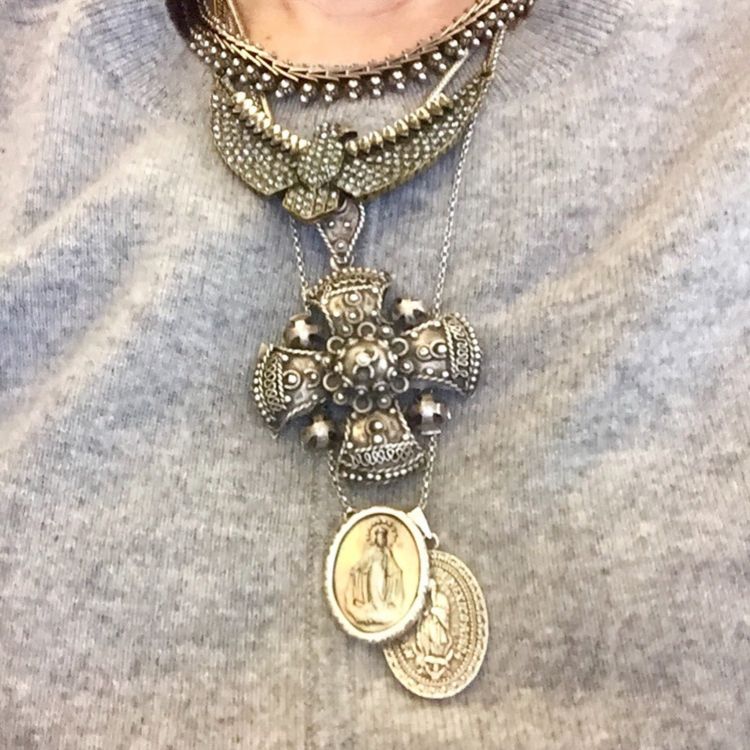
A small gold cross worn every day can sit beautifully with a white shirt, cashmere knit or simple black dress. A diamond cross needs little competition and looks strongest against an open neckline or plain fabric. Larger baroque crosses can be styled over black, navy or white, allowing the jewellery to do the talking.
Layering is also possible. Wear a cross with one or two simple chains in different lengths, but give it enough space to remain visible. If the cross is meant to communicate faith, surrounding it with five unrelated talismans, zodiac signs and novelty charms may confuse the message. The neck should not resemble the lost-property drawer at a summer festival.
Respect does not require dullness. It requires intention.
Avoid wearing a cross in a deliberately mocking or degrading context. Do not use a crucifix merely to manufacture controversy. And do not assume that covering a sacred symbol in diamonds automatically makes it vulgar. Vulgarity is more often found in the attitude than in the carat weight.
And no, a rosary is not simply a necklace
A rosary includes a cross, but it is not a long cross necklace. It is a prayer instrument, with beads arranged to guide the Our Fathers, Hail Marys and meditation on the mysteries of Christ’s life.
The Catholic Church does not expressly forbid wearing a rosary around the neck. In some countries and religious traditions, people do wear one as an expression of devotion or a reminder to pray. Intention and cultural context matter. Catholic guidance emphasises that a rosary may be worn devotionally but not treated merely as jewellery.
Still, using a rosary simply to accessorise an outfit is missing the point. There are countless beautiful cross necklaces designed to be worn. Choose one of them.
Wearing a rosary you do not pray because it “looks cool” is not rebellious. It is faintly ridiculous—like carrying a violin everywhere because the case matches your coat.
Wear the cross beautifully, but know what it means
The cross can be small or splendid, plain or covered in diamonds. It can be inherited, received at a sacrament or chosen as a personal declaration of faith. There is no requirement to hide it and no virtue in making it deliberately unattractive.
Wear it with your white shirts, black dresses, tailoring and denim. Layer it intelligently. Choose a design that feels like you.
But remember what comes before the styling: the Crucifixion, the Resurrection and Christ’s promise of eternal life.
That is what gives the cross its beauty. The gold merely catches the light.
Images ©notoriousmag, @notorious AI, @Christian Lacroix, ©Dolce&Gabbana, @Verdura