This article examines the transformation of a couture atelier into an entrepreneurial system, based on practical experience in the luxury bridal and performance costume segment, including work in international markets. The purpose of the study is to describe a manageable model that combines bespoke design, predictable timelines, and a sustainable production economy.
The methodology includes an analysis of the client journey (from initial inquiry to final delivery), principles of product line development (including bridal peignoirs as an assortment extension), cost-structure-based pricing approaches, and protocols for collaboration with boutiques. The study demonstrates that formalising production stages, standardising quality checkpoints, and applying a structured communication funnel (inquiry → consultation → proposal → deposit → fittings → delivery) increase workload manageability and reduce operational risks.
The practical significance of the study lies in its recommendations for creating sustainable business processes for ateliers operating under high client expectations and complex logistics.
Introduction
The luxury bridal fashion and performance costume segment is characterised by high margins, but also by high order variability, scheduling risks, and a significant proportion of manual labour. As a result, sustainability in this niche is determined not only by a designer’s talent but also by operational discipline—the ability to manage an order portfolio, standardise quality, and build a clear, reliable client experience.
International practice adds additional demands on communication and logistics: client expectations vary across markets, while brand trust is built through process transparency, service quality, and the predictability of results.
1. Product in Couture: Individuality + System
In the couture model, the product is not only the garment itself, but the entire service framework, including:
- consultation and design concept development;
- fitting protocols;
- production and quality control;
- delivery and post-delivery support.
For scalability, it is essential to distinguish between:
- unique elements (design, visual concept, artistic components);
- repeatable elements (construction modules, finishing standards, documentation, and process stages).
It is precisely the repeatable components that make it possible to maintain quality while increasing order volume.
2. Client Funnel and Managed Communication
In the luxury segment, communication is part of the product. A typical client funnel includes the following stages (see Figure 1):
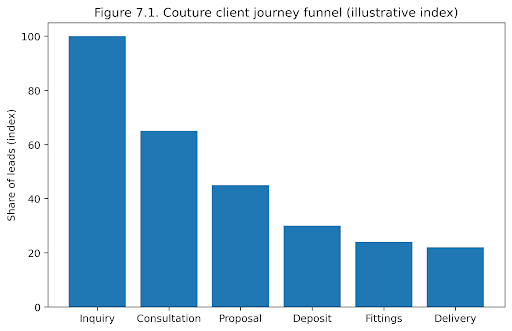
- Inquiry;
- Consultation;
- Proposal;
- Deposit;
- Fittings;
- Delivery.
At each stage, the following elements are documented:
- client expectations;
- quality criteria;
- timelines and constraints;
- conditions for change requests.
This approach reduces conflict and makes complex bespoke projects more manageable.
3. Product Line Development as a Risk Mitigation Tool
Assortment expansion (for example, bridal peignoir collections) creates a “semi-standardised” product layer characterised by:
- shorter production cycles;
- more predictable cost structures;
- easier scalability through boutiques and online channels;
- greater potential for repeat sales.
In couture, this approach is particularly important: a line of accessories and complementary items “around the dress” increases revenue stability and reduces dependence on single, high-value custom orders.
4. Unit Economics and Cost Structure
Sustainability requires a transparent cost structure, including labour, materials, fittings, alterations, overhead, and logistics. An illustrative cost breakdown for a couture bridal garment is presented in Figure 2.
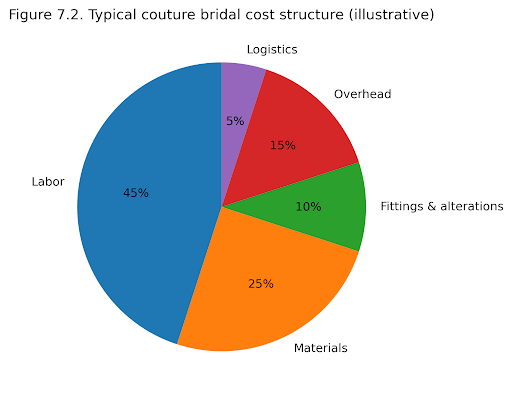
In practical terms, this means:
- labour standardisation by production stages;
- identification of high-risk zones (embellishment, fit, final finishing);
- Introduction of clear rules defining “what is included” and “what is treated as additional” (design changes after approval).
5. Operational Model for Boutique Collaboration
Working through boutiques requires:
- unified standards for quality and packaging;
- clearly defined SLAs for timelines;
- alignment on fitting and change policies;
- management of reputational risks (in the luxury segment, negative reviews are particularly sensitive).
For international markets, adapting communication is critical: service presentation style, degree of formality, response speed, and product presentation format must be aligned with local expectations.
Conclusion
A couture business is sustainable when artistic uniqueness is supported by a system: a structured communication funnel, fitting protocols, cost management, and a well-developed product line. International practice increases the value of the standardizable parts of the process, as they are precisely what create trust and consistency of quality across markets. Developing collections (such as bridal peignoirs) allows brands to expand their offerings, improve economic predictability, and establish themselves as systematic players in the luxury segment.
References
- Kotler P., Keller K. Marketing Management. — Pearson, 2016.
- Osterwalder A., Pigneur Y. Business Model Generation. — Wiley, 2010.
- Ries E. The Lean Startup. — Crown Business, 2011.
- Armstrong H. J. Patternmaking for Fashion Design. — Pearson, 2019.
- Shaeffer C. Sewing for the Apparel Industry. — Pearson, 2014.
Guest Writer: Tetiana Kibkalo, Expert in fashion design and entrepreneurship in the luxury bridal and performance costume industry